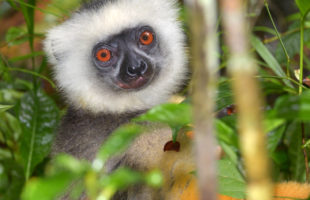
The Silky Sifaka (Propithecus candidus) is one of the most beautiful and special lemurs of Madagascar, but also one of the rarest. There are only about 250 sexually mature silk sifakas left in Madagascar, otherwise they do not occur anywhere else in the world. For comparison: In Asia alone there are still around 3000 to 5000 full-grown specimens of tigers …
LesenSchlagwort-Archiv: ecotourism
The Tree of Travelers
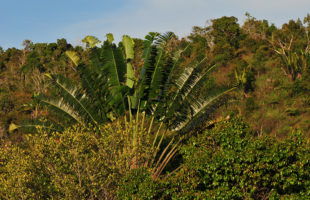
The Ravenala, better known as the tree of travelers, belongs to the strelitzia family, despite resembling a palm tree. Although it is now common all over the world and is even cultivated as an ornamental plant in some homes, it originated in Madagascar and only occurs naturally there. Ravenalas grow from six to thirty meters and are particularly known for …
LesenDarwin’s orchid
As early as 1802, French colonialists in Madagascar discovered a unique, white-flowering orchid whose waxy blossom had a diameter of a good 12 cm. They had never seen anything like it, and so it was also a Frenchman named Du Petit-Thouars, who 20 years later wrote down a description of the peculiar flower for the first time. He called it …
LesenBaobab Avenue
The legendary Baobab Avenue is located on the road (or let’s better say the dusty slope) between Morondava and Belo sur Tsiribinha in west Madagascar. It is in the province of Menabe. Everywhere along the road between those two cities, you can find the impressive Baobab trees, only a small part of 250 meters length is known as Baobab Avenue …
LesenMasoala national park
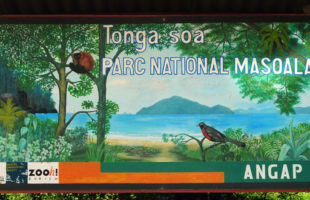
Masoala: Masoala means “eyes of the forest”. The national park owes this name to the Aye-Aye (Daubentonia madagascariensis), whose eyes ghostly glow like two large yellow spheres in the light cone of the torch at night. Unfortunately, night walks in national parks are currently forbidden, so that only the name testifies to this magnificent experience. Location: The Masola National Park …
LesenNo life without the Ocotillo: Verreaux’ Sifakas
The Verreaux’ Sifakas (Propithecus verreauxi) lives in the south of Madagascar and belongs to the few lemurs that successfully colonize the hot and hostile spiny forests. It is a very adaptable species that can survive even in very small forest areas. It can even be found in some lowland rainforests in the southeast of the eighth continent. In the northwest, the …
LesenA diadem of fur: Diademed Sifakas
The Diademed Sifaka (Propithecus diadema) is with a total length of 105 cm and a weight between five and seven kilograms one of the largest lemurs of Madagascar and because of its unusual fur colors also one of the most beautiful. His face is framed by long white fur, which looks a bit like a tiara and gave these lemurs …
LesenSt. Marie (Nosy Boraha)
The two islands St. Marie (in Malagasy Nosy Boraha) and Nosy Nato are located at the East coast of Madagascar and belong to the province of Toamasina. Especially Nosy Boraha is, besides Nosy Be, one of the most visited islands of Madagascar and has a good infrastructure. St. Marie is relatively large, around 50 km long, above two to seven …
LesenRanomafana National Park
Ranomafana: Ranomafana owes its name to its thermal springs, which constantly pump warm water (in Malagasy rano mafana) into the valley. Location: Ranomafana National Park is located between the two regions of Haute Matsiatra and Vatovavy-Fitovinany, about 420 kilometers south-east of the capital Antananarivo. For the journey via the RN7 from the capital, you need about one and a half …
LesenThe animal that brings death
No other animal in Madagascar has as many myths and fairy tales as the Aye-Aye (Daubentonia madagascariensis). Throughout the northern half of Madagascar, it is fady, which means taboo. Unfortunately, this fady does not mean that the animals are not touched by Madagascans, as with chameleons, for example. Instead, many inhabitants of Madagascar believe that the encounter with an aye-aye …
Lesen
MADAMAGAZINE Your Magazine about Madagascar